
A 174-page plain-language field guide for operators and young engineers: how exchangers work, every main type, monitoring, testing, fouling, troubleshooting, cleaning and economics.
USD 29
| Format | PDF, A4, 174 pages, 48 diagrams and charts, 10 picture pages |
| Edition | Edition 1.0 (October 2026) |
| Readers | Operators and junior engineers; useful refresher for seniors |
| Units | SI first, US in brackets |
| Sources | Shah & Sekulić, Perry, Branan, TEMA, API and others — cited in our own words |
| Free sample | Chapters 1–3 in the free Starter Pack |
Single-user licence. Team and site licences: see options. Instant download after payment; you also get updates to this major version. The file itself is in English.
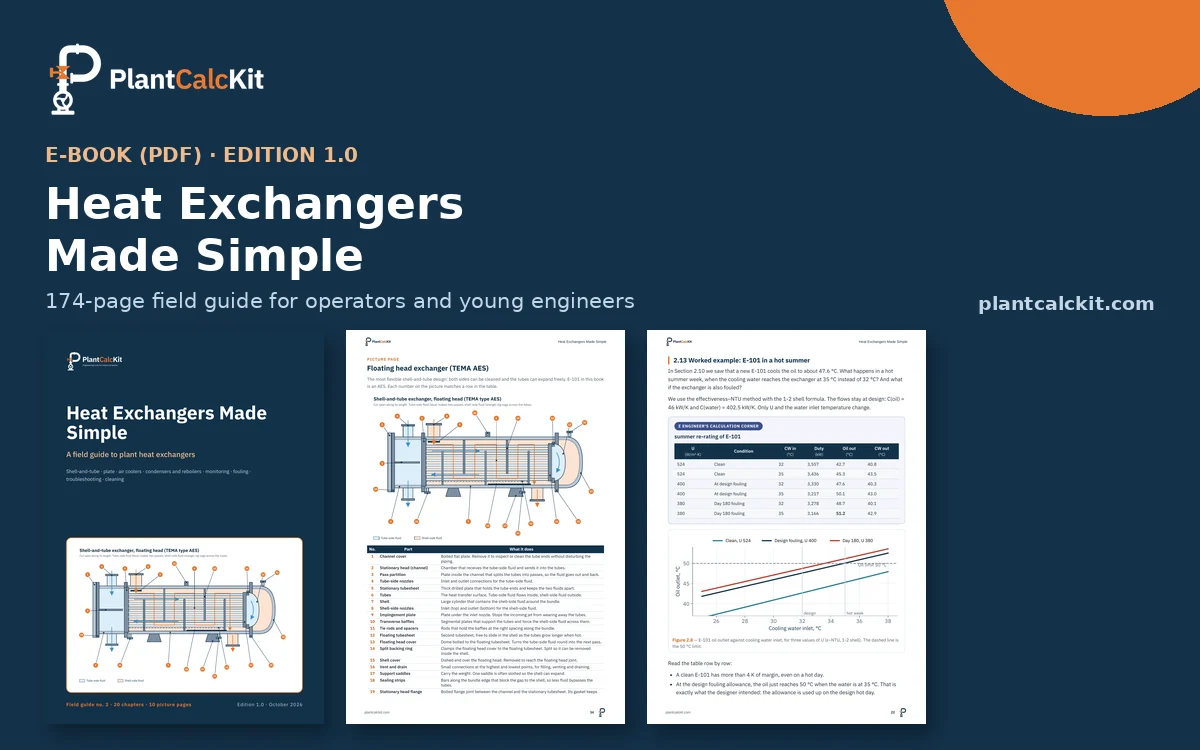
What it does
20 chapters, 174 pages, 48 diagrams
From heat transfer in plain words to monitoring, fouling, cleaning, safe operation, heat recovery and upgrades.
10 picture pages
A cutaway of each main type — AES, BEM, BEU, hairpin, plate, air cooler, surface condenser, kettle, thermosiphon and waste heat boiler — with 190 parts numbered and explained.
Six example exchangers
An oil cooler, a plate cooler, a surface condenser, an air cooler, a kettle reboiler and a waste heat boiler, followed through the whole book.
Worked numbers, not just words
Hot-day re-rating, fouling trends and forecasts, steam pressure a fouled reboiler needs, condenser back-pressure, cleaning intervals and payback.
Troubleshooting guide
A five-step method, symptom tables, fault stories from the plant and a fully worked case.
Printable extras
Checklists, formulas and units, typical values, quizzes, glossary, FAQ and a sample performance report.
What's inside
- Why heat exchangers matter
- Heat transfer in plain words
- The exchanger family at a glance
- Shell-and-tube exchangers
- Double-pipe and hairpin exchangers
- Plate heat exchangers
- Air-cooled exchangers
- Condensers
- Reboilers and vaporisers
- Waste heat boilers, gas coolers and intercoolers
- Daily monitoring
- Performance testing
- Fouling
- Corrosion, leaks and tube failures
- Troubleshooting guide
- Cleaning
- Inspection and maintenance
- Start-up, shutdown and safe operation
- Energy, heat recovery and sustainability
- Upgrades and economics
Plus appendices: glossary, checklists, formulas and units, typical values, FAQ, a sample performance report and references.