
Predict cold water for any weather, flow, load or fan condition — and compare fill, fan and extra-cell upgrades with payback.
USD 49
| Format | Excel workbook (.xlsx), no macros |
| Version | v1.0 |
| Works in | Excel 2010 or later, Windows and Mac |
| Units | SI, US and British, mixed freely |
| Includes | Guide tab with method and references, calculator, print-ready report |
| Free version | Try the online calculator |
Single-user licence. Team and site licences: see options. Instant download after payment; you also get updates to this major version.
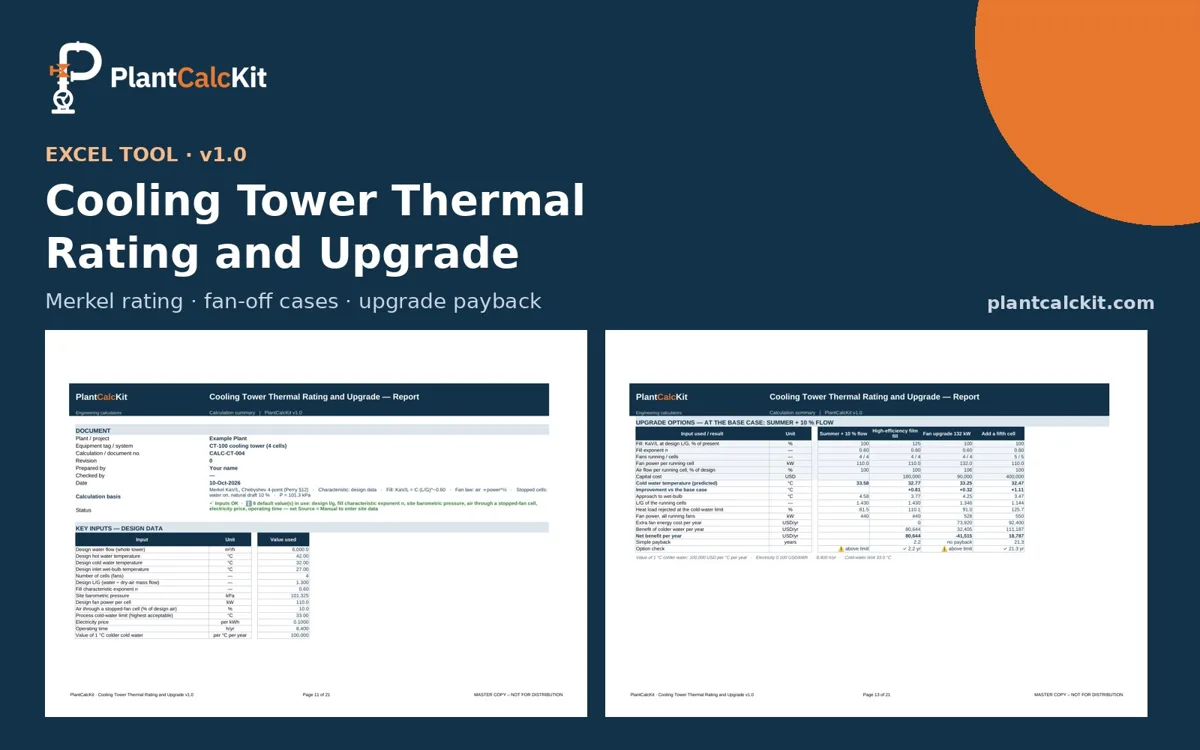

What it does
Merkel rating
Design KaV/L and fill characteristic from your design point; predicted cold water at any wet-bulb, flow, load or fan power.
Four cases at once
For example design, summer peak, extra flow and one fan off.
Fan-off and stopped cells
Natural-draft air through a stopped cell and mixed cold water by mass balance.
Upgrade options
High-efficiency fill, bigger fans or an extra cell — colder water, extra heat load and payback for each.
Measured-test check
Capability from a measured test by the characteristic-curve approach.
Predicted curves
Cold water against wet-bulb for 90/100/110 % flow, ready to print.
Built for engineers
- Visible formulas — nothing hidden, so you can check every step.
- Fully referenced — methods from the standard references, checked against their published worked examples.
- Safe to share — sheets are protected against accidental edits, with an open password so you can still customise.
- Built-in input checks — clear warnings for impossible inputs and values outside typical ranges.
For engineering estimates; verify against site data. Code-based methods are aligned with the publicly documented procedure; they are not a licensed reproduction or a certification.